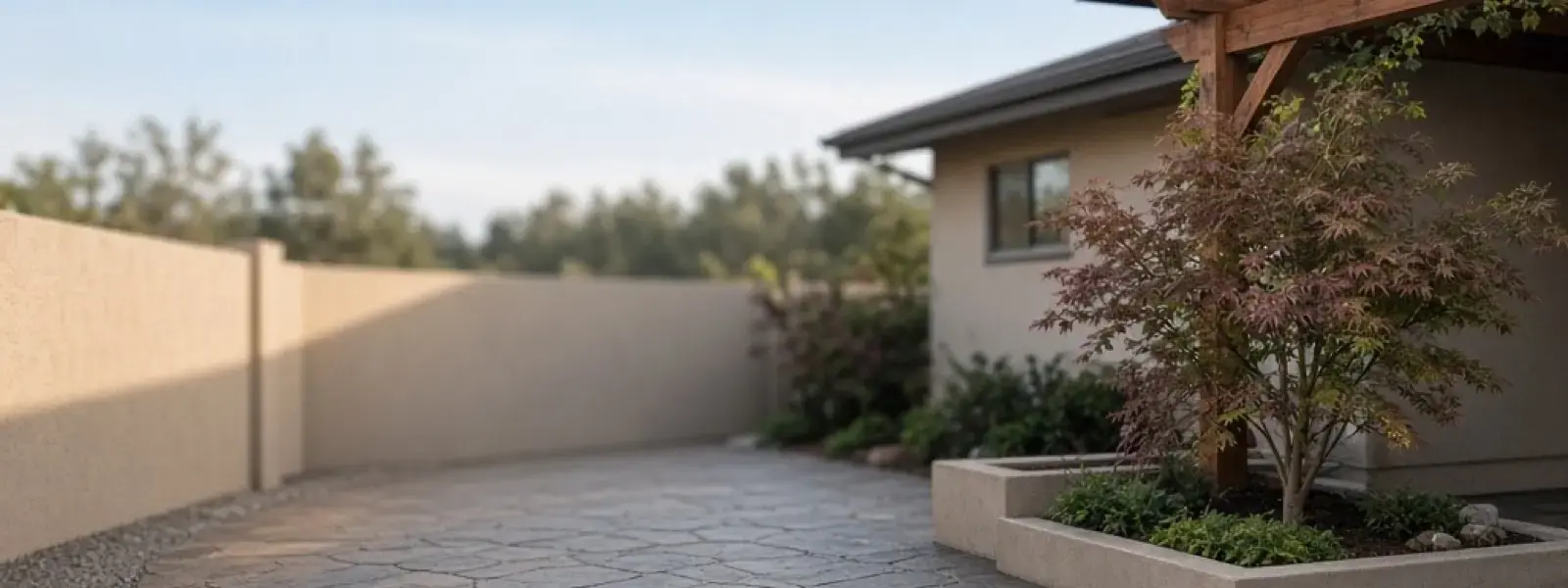
Almost every patio conversation we have comes down to the same three choices: interlocking pavers, stamped concrete, or flagstone. They can all look great, and they can all fail. The difference is how each one reacts to the things that actually go on in a Bay Area yard, like clay that moves with the seasons, hot dry summers, a wet winter, and a house that wasn't built yesterday. San Jose Hardscapes installs all three, so we have no reason to push you toward one.
Here's an honest comparison, side by side, on the stuff that matters after the first summer. We'll skip dollar figures, because cost swings with access, soil, size, and design, but we'll be clear about which option costs more up front and which tends to cost more later. At the end there's a simple framework for picking.
Movement tolerance and repairability
This is the big one in the Santa Clara Valley, where expansive clay swells and shrinks every year. Pavers are the most forgiving. They sit on a compacted aggregate base and about 1 inch of bedding sand, and the joints are filled with sand, so the surface can flex a little without breaking. If a section settles, you lift the pavers, fix the base, and put the same units back. Repair is a local job, not a demolition.
Stamped concrete is a rigid slab. It handles load well, but it doesn't handle differential movement well. Good practice calls for control joints cut or tooled at a spacing roughly 2 to 3 times the slab thickness in feet (so about 8 to 12 feet for a 4-inch slab), reinforcement such as rebar or fiber, and a well-compacted base. Even then, hairline cracks can show up because concrete shrinks as it cures. Cracks are hard to hide in a pattern, and a patch rarely matches the original color or texture.
Flagstone depends entirely on how it's set. Dry-laid on a compacted base with sand or fine gravel joints, it moves a lot like pavers and can be reset piece by piece. Mortared over a concrete slab, it behaves like the slab, and mortar joints crack when the slab moves. If your soil is poor, a flexible dry-laid system is more tolerant than a rigid one.
Heat, slip resistance and sealing
Bay Area summers can get properly hot inland, and a dark surface in full sun holds that heat. Lighter colors stay cooler under bare feet no matter the material. Natural stone like flagstone is often a bit cooler than dark concrete products, but color matters more than the material. Pavers have joints and a slight texture, so they tend to feel less harsh than a big sheet of troweled concrete. If you've got kids, pets, or a pool, test samples in the sun at 3 in the afternoon, not in the shade of a showroom.
Slip resistance is about texture and drainage. Stamped concrete can be slick when wet, especially with a glossy sealer, so a slip-resistant additive in the sealer or a textured release pattern is a smart choice. Pavers give you grip from the surface texture and the joints, and flagstone's natural riven face helps, though smooth cut flagstone can get slippery with algae in shady, damp spots. Standing water is the real enemy. A patio with a proper 2 percent slope dries faster and is safer.
Sealing is its own story. Stamped concrete almost always gets a sealer, usually acrylic, and it needs to be reapplied every few years to hold color and resist stains. Sealers meeting ASTM C309 or C1315 are the common types. Pavers are often sealed too, but it's optional, and some owners prefer an unsealed look. Flagstone can be sealed to deepen color and resist stains, but many people leave it natural. Whatever you pick, a sealer is a maintenance item, not a one-time event.
Maintenance and color fade
All three need some care. Pavers need their joints topped up with polymeric sand when it washes out, and weeds will find any sand-filled joint if you let them. An occasional rinse and a refresh of the joint sand does most of it. Pavers are made with integral color, meaning the pigment runs through the unit, so fading is gradual and even.
Stamped concrete is usually colored in two ways. Integral color is mixed into the whole batch, and a color release agent is broadcast on top during stamping for the antiqued look. The release agent sits near the surface, so it's the first to wear, especially in high-traffic areas, and sun exposure does fade pigments over time. A fresh coat of sealer brings back the look but doesn't restore worn color. If you like the stamped look, expect to maintain it on a schedule.
Flagstone is natural stone, so the color is the stone itself, and it doesn't fade in any way you'd notice. It does weather, grow lichen in shady spots, and get dusty on a dry-laid patio. If you're prepared to sweep and occasionally re-sand joints, it's the lowest-fuss material on this list.
Look, install complexity and cost direction
Pavers give a clean, designed look: herringbone, running bond, mixed-size patterns, banded borders. The look is controlled and consistent, with a wide range of colors and textures. Installation is labor-intensive but methodical. It's excavation, base, compaction, screed, set, cut, edge restraint, and joint sand, and a good crew works steadily through each step. Complexity grows with curves, patterns, and cuts.
Stamped concrete can imitate stone, slate, brick, or wood grain from a distance, and it has no joints to speak of, so it's a good fit for large simple areas. But it's the least forgiving to install. Concrete has a short working window, so timing, weather, finishing, stamping, and curing all have to line up, and you can't fix a mistake once it sets. Follow ACI 302 practices for placing and finishing, and ask who is actually stamping, because skill shows up in the final result.
Flagstone is the most custom. Every stone is different, so each is fitted by hand, and the installer's eye makes the patio. That's slow work, and material choice and thickness matter. Qualitatively, flagstone usually costs the most up front, quality pavers sit in the middle, and stamped concrete tends to cost less up front, though repairs and resealing can narrow that gap later. Costs vary a lot with scope, so get a written estimate for your own yard.
Resale and HOA rules
Buyers tend to read a patio quickly. A clean, level paver or stone patio with tidy edges reads as quality. A stamped slab with visible cracks, patched sections, or worn color can read as deferred maintenance. That's not a knock on stamped concrete, since a well-built and well-kept one looks sharp, but it's honest. Natural flagstone and good pavers usually age more gracefully.
HOAs are their own thing. Many associations have rules about materials, colors, patterns, and sometimes the footprint or the setback of hardscape, particularly in townhome communities and newer subdivisions. Some require approval before work starts, and some limit hard surfaces to keep drainage manageable. Check your CC&Rs and talk to the board before choosing a design, and get approvals in writing. Some cities also have rules on how much of a lot can be covered by hard surface, so it's worth a call to the planning department.
Another resale point: if your yard has a drainage issue, it's usually better to fix it as part of the patio than to stack a nice surface on top of a wet problem. Buyers' inspectors look at that.
A simple way to decide
If your soil is clay, your yard moves, or you want the option to repair or change things later, start with pavers. They're the most tolerant, easiest to fix, and come in a wide range of looks. If you want a large, uninterrupted area in a pattern that suggests stone, the budget is a bit tighter, and the ground is stable and well drained, stamped concrete is a legitimate fit, as long as you accept the sealing schedule and that cracks are a possibility.
If you want a natural, one-of-a-kind look and you're willing to accept irregular joints and more labor, choose flagstone. It's at its best in a garden setting, around a firepit, or as stepping stones through planting.
Ask yourself four quick questions. How's the soil and drainage? How much do you want to maintain? How will the surface feel in July? And do you need HOA approval? Your answers usually point to one material, and a site visit confirms it. Whichever you pick, the base, compaction, slope, and edges matter more than the surface on top.
There's no universal winner, just the right match for your soil, your yard, and how you live in it. If you're still weighing the three, San Jose Hardscapes can look at the site, talk through drainage and HOA rules, and lay out how each option would be built on your lot. Then you can choose with real information instead of a showroom sample.
Written by San Jose Hardscapes Team.