San JoseHardscapes
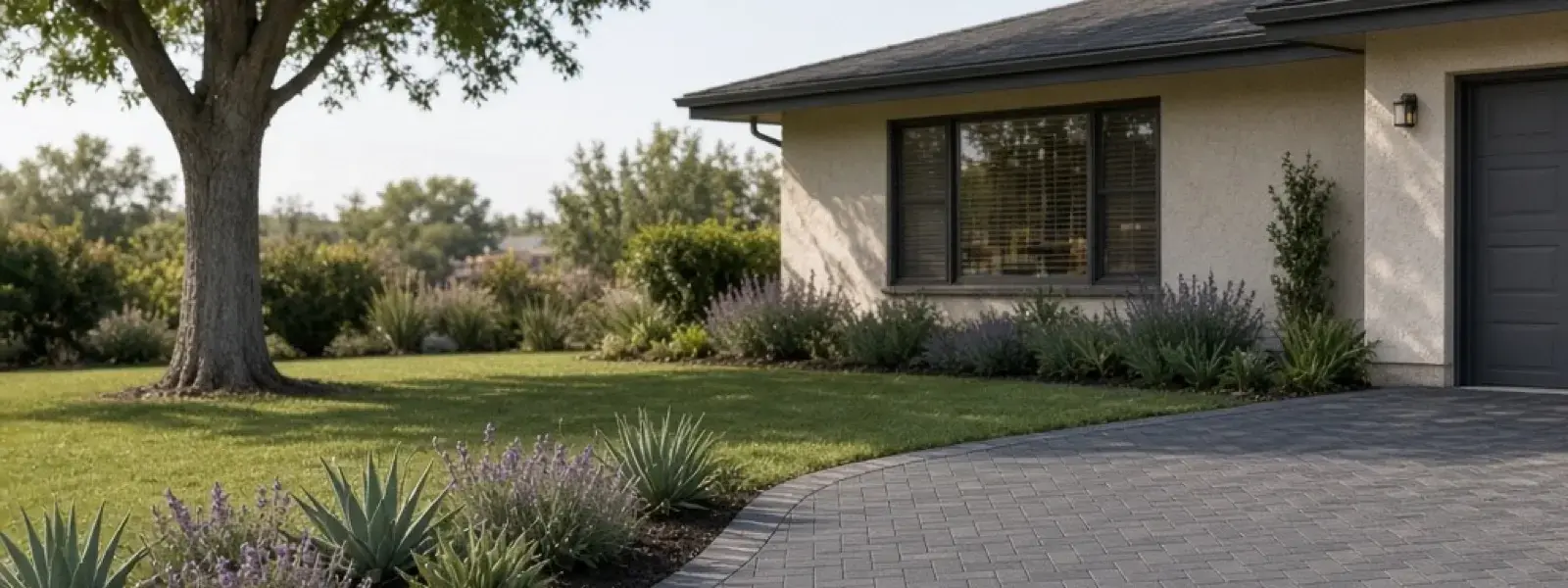
New charcoal herringbone paver driveway with a soldier course border at a San Jose ranch home

Hardscaping Services

Paver Driveway Installation in San Jose, CA

Vehicle-rated pavers over a thicker base, locked in by a proper edge restraint.

The short answer

A paver driveway in San Jose uses 80 mm pavers over a much deeper compacted base than a patio, often with geotextile or geogrid over soft clay, plus a concrete or soldier-course edge that resists wheel loads. Herringbone patterns handle braking and turning forces. The street connection may need city approval. Cost depends on size, soil, access and paver choice.

A driveway takes more punishment than any other surface at your house. It carries a couple of tons of metal a few times a day, sees oil drips, sits in July sun and gets soaked in January. San Jose Hardscapes builds paver driveways with that in mind, which means more base, tougher edges and a lot of attention to what happens at the garage and at the street.

If you're weighing pavers against poured concrete for your San Jose driveway, the pitch for pavers is real but conditional. Individual units move together under load and can be lifted and reset when a utility trench or a settled spot needs attention. That flexibility is useful in clay. But a paver driveway built like a patio will rut, so the build is different from top to bottom.

Below is how we approach it, from paver thickness and base depth to the apron, drainage and what happens when oil or tire marks show up. If you're also comparing materials, our concrete driveway installation page covers the poured option, and we're happy to talk honestly about which one fits your lot.

Why people call

Reasons to call about paver driveway installation

01

A cracked, stained or heaved concrete driveway

Clay movement, tree roots and heavy trucks crack concrete. Pavers don't fix the cause, but they handle the movement more gracefully, and a damaged section can be taken up and relaid without tearing out the whole drive.

02

A driveway extension or widening

A lot of homes need another car space or a place for an RV or trailer. New pavers can be matched into an existing driveway, but the new base needs to tie in carefully to the old one so the two don't settle differently.

03

A garage conversion or ADU

When the garage becomes living space, the driveway often needs to change in size and shape. That's a good time to rethink the layout, the drainage and the connection to the street.

04

Curb appeal before a sale or after a remodel

A new driveway frames the house. People notice it before they notice anything else. If you're planning a front-yard remodel, the driveway is usually the biggest single surface you'll see.

05

Drainage or oil-stain problems

A driveway that floods the garage threshold or pools at the sidewalk needs more than new surface. The grade, drains and apron all have to work together, and we can look at permeable options where they make sense.

What's in the job

What the job actually includes

01

Demolition and haul-off

If there's an old slab or asphalt, we saw-cut and remove it, then haul it away. We also deal with old base material, buried roots and any abandoned pipes or conduits we turn up during excavation.

02

Deep excavation and subgrade evaluation

We dig to the depth the soil calls for, typically a foot or more below finished grade once pavers, sand and base are accounted for. The exposed soil gets proof-rolled so we can see what's soft, wet or full of organic matter.

03

Reinforced base build

On firm soil it's a thick compacted aggregate base. On soft clay it's geotextile, sometimes geogrid, and a deeper base built in thin lifts. We compact each lift and check slope before moving on.

04

80 mm pavers, laid in herringbone

We use 80 mm interlocking concrete pavers made for vehicle loads, laid in a 45 or 90 degree herringbone so the joints interlock in several directions. We cut the border neatly and keep the joints tight and even.

05

Soldier course and edge restraint

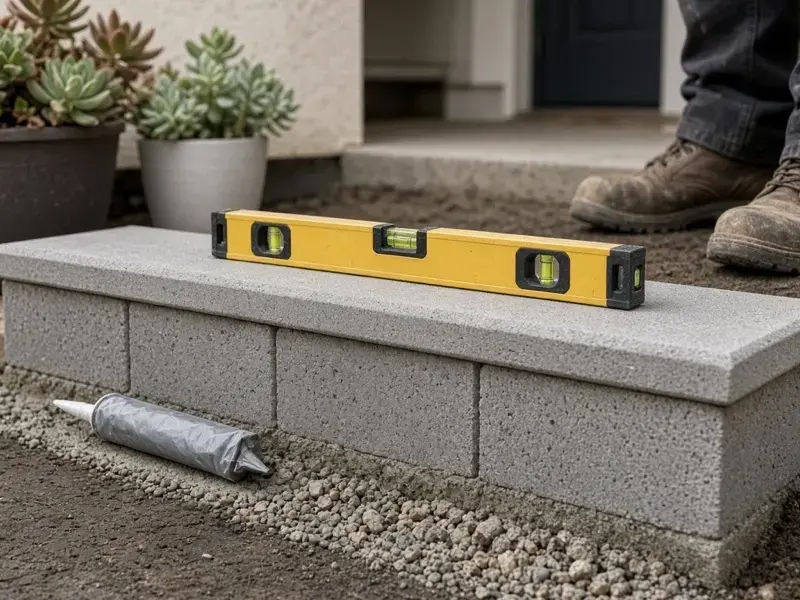
A soldier-course border frames the driveway and ties the field together. Behind it we usually pour a concrete edge or curb, because plastic restraint alone isn't enough on a driveway.

06

Apron, garage transition and joint stabilization

We build the transition at the garage slab and at the street so the car rolls on and off smoothly, fill the joints with polymeric sand and, if you want, apply a sealer that helps with stains and sand retention.

The build

How we build it, step by step.

  1. 01

    Survey the lot and check utilities

    We measure slope from the street to the garage, mark every buried line by calling 811, and note water meter boxes, cleanouts and tree locations. We also look at how water currently moves across the drive and onto the street.

  2. 02

    Demolish and excavate

    We remove the old surface and dig out to a depth that suits the soil. We usually work in sections if the driveway is the only way in and out, so there's access for the household.

  3. 03

    Evaluate and stabilize the subgrade

    The exposed clay gets proof-rolled and compacted. Soft or pumping areas are dug out and replaced. If the soil is wet or weak, we lay non-woven geotextile and possibly a layer of biaxial geogrid to spread the load.

  4. 04

    Build the base in thin lifts

    Crushed aggregate goes in at a total depth of roughly 8 to 12 inches for typical residential traffic, and deeper in poor soil or for heavier vehicles. Each lift is about 4 inches, compacted to 95 percent or better of Standard Proctor (ASTM D698), with the slope checked as we go.

  5. 05

    Set edges and screed the bedding sand

    Concrete curbs or edge restraints go in first, so the pavers have something solid to push against. Then we screed about 1 inch of ASTM C33 concrete sand over guide pipes, keeping it thin and consistent.

  6. 06

    Lay pavers and compact

    We lay 80 mm pavers in herringbone from a straight line, cut the borders with a wet saw and compact the whole surface with a heavy plate compactor. We often make a second pass after the joints are filled with sand.

  7. 07

    Build the apron, stabilize joints and seal if chosen

    The street connection gets built to whatever the city requires. Joint sand is swept in, compacted and cleaned. A sealer can go on after the pavers have had time to dry and cure, depending on the product.

Technical detail

The details that decide how it holds up

Why 80 mm pavers and a thicker base

Patio pavers are usually 60 mm thick. For driveways, the Interlocking Concrete Paver Institute and most manufacturers recommend 80 mm, about 3 1/8 inches. The extra thickness helps the pavers resist breaking under wheel loads and gives a stiffer interlock in the joints. They should meet ASTM C936 for compressive strength and absorption.

But the paver is the thin part of the system. Vehicle loads travel down through the units and the sand into the base, and from there into the soil. If the base is thin, the soil gets point loads and starts to rut under the wheel paths. For a residential driveway, a compacted base of about 8 to 12 inches is typical over decent soil, and more is common where the soil is weak or the vehicles are heavy.

Every site is different. A driveway for a pair of sedans on well-drained alluvial soil doesn't need the same build as one that hosts a delivery van over wet adobe clay. We evaluate the soil, ask what's parked there and recommend a base accordingly. Skipping the base to save money is the surest way to end up with ruts.

Clay, geotextile and geogrid

Expansive clay is the main challenge under driveways in much of the valley. When it's dry it's hard, and when it's saturated it turns soft and loses a lot of its bearing strength. A driveway base built directly on soft clay can sink into it over time under repeated wheel loads. That's called pumping, and it's how you end up with parallel dips in the wheel path.

Geotextile is a separator. It's a non-woven fabric laid over the compacted subgrade that keeps the clay and the base stone from mixing. Geogrid is different. It's a stiff grid of polymer strands that interlocks with the aggregate and spreads the load sideways, so the soil sees less pressure. On weak clay, we sometimes use both: fabric against the soil and a layer of biaxial geogrid within or at the bottom of the base.

Neither material replaces a good base, and neither is needed on every job. But on soft or wet ground, they can let us build a thinner base than we'd need otherwise, or help a base perform better. We'll show you what we find in the subgrade and explain what we recommend and why.

Herringbone, soldier courses and edge restraint

Pattern isn't just about looks on a driveway. A herringbone pattern, whether at 45 or 90 degrees to the direction of travel, locks the units together in multiple directions, so a braking or turning tire can't easily push a row sideways. A running bond laid parallel to traffic has continuous joint lines that tend to creep. A 45 degree herringbone is a favorite among installers for the traction it provides, though it takes more cuts at the border.

The border matters too. A soldier course, a row of pavers laid end to end along the edge, gives the field something solid to lock against. It's usually paired with a concrete curb or haunch behind it, because the lateral force from turning tires is large. Plastic restraint alone, spiked into the base, can work on lighter-duty driveways, but we generally prefer concrete edges on a driveway.

Where the driveway meets the garage slab, a clean transition and a good base under the last few feet make a big difference, because that's where most turning and braking happens. We often set a soldier course across the garage door line too, so the pattern ends cleanly and the surface stays level.
The apron, the street and the right-of-way

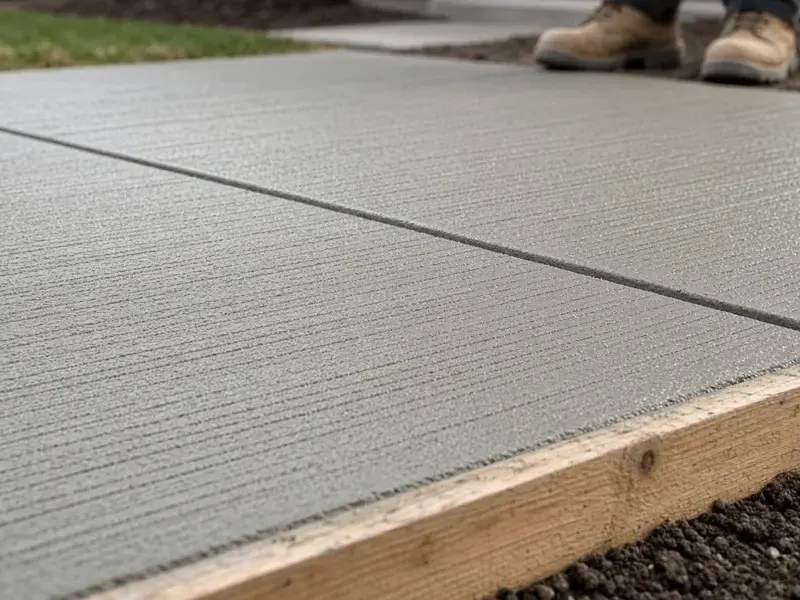
The apron is the strip where your driveway crosses the sidewalk or parkway and meets the street. It's usually in the public right-of-way, which means the city has a say in what it looks like and how it's built. Many cities require a concrete apron or a specific section, and some require an encroachment or driveway permit before any work starts. We can't tell you the exact rule for your address, so check with the city's public works department.

Even if the apron has to be concrete, the paver driveway behind it can still meet it cleanly. We build the transition so the first paver sits slightly proud of the apron edge, or use a short concrete band to separate the two, and we shape the grade so a car doesn't scrape its bumper on the way in.

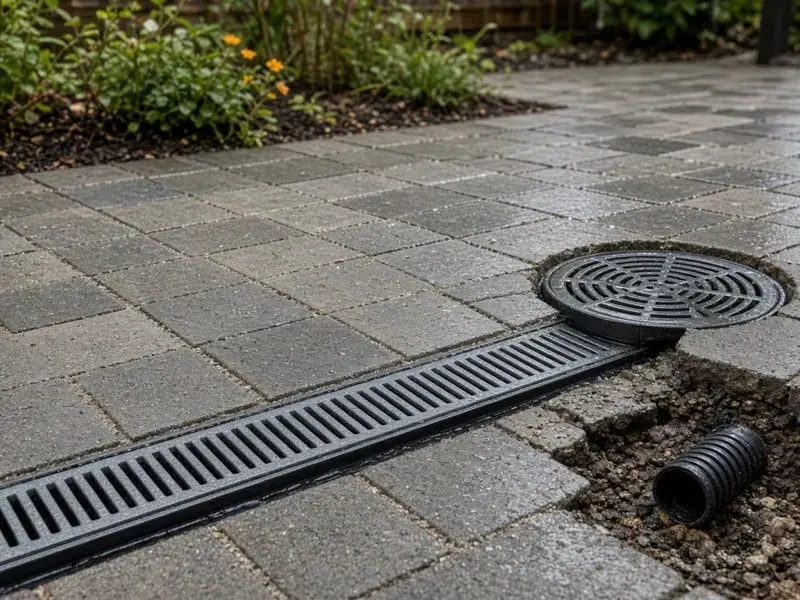
Slope matters here, too. Water from your driveway shouldn't run across the sidewalk or into a neighbor's yard. We pitch the surface so it drains toward the street or a drain inside your property, often with a slot or trench drain at the garage or at the bottom of a sloped drive.

Drainage, permeable pavers and a few honest caveats

A standard paver driveway sheds water through the surface, just like concrete, and the joints are filled with sand that lets a little through. It isn't truly permeable. If you want a driveway that actually soaks up rain, there's a separate system called permeable interlocking concrete pavement, built with special pavers that have wider joints filled with small clean stone, over layers of open-graded stone designed to hold water.

Permeable systems can reduce runoff and may be encouraged by some cities, but they're not right for every lot. On heavy clay that drains very slowly, the stone reservoir may need an underdrain pipe to a safe outlet, which adds complexity. They also need occasional vacuum cleaning to keep the joints open. Some cities and stormwater programs have specific rules, so check before you commit.

Whether the driveway is permeable or not, the downhill end needs attention. If it drops toward the garage, a channel drain across the door is often smart. A well-placed French drain beside the driveway can also catch groundwater that tends to push toward the garage slab in the wet season.

Spec sheet

Paver Driveway Installation: the numbers

Paver thickness
80 mm (about 3 1/8 in), ASTM C936 for vehicular use
Compressive strength
8,000 psi minimum average, tested per ASTM C140
Base depth
Typically 8 to 12 in compacted, more over weak clay
Base material
3/4-inch minus crushed aggregate, placed in about 4 in lifts
Compaction
95 percent or better of Standard Proctor (ASTM D698)
Subgrade reinforcement
Non-woven geotextile, plus biaxial geogrid over soft clay as needed
Bedding layer
About 1 in of ASTM C33 concrete sand
Pattern
Herringbone at 45 or 90 degrees for interlock and traction
Edge
Soldier course backed by a concrete edge or curb
Cross slope
At least 1/4 in per foot (2 percent) so water leaves the surface

Failure modes

How these jobs go wrong

Most failures trace back to a handful of shortcuts. These are the ones we see most.

  • Using patio specs on a driveway

    A 60 mm paver on a 4-inch base is fine for a patio and it'll rut under a car. Driveways need 80 mm pavers, a deeper base and a stiff edge. It's the most common failure, and it shows up in the wheel paths first.

  • Ignoring the soil under the base

    Building on soft, wet clay without a separator or reinforcement is a recipe for pumping. The base slowly sinks into the clay and leaves dips. Looking at the subgrade before building is one of the least expensive steps in the job.

  • Plastic edging on a high-traffic edge

    Turning tires push outward on the pavers at the edge. Light restraint can't hold against that force and the border starts to spread. A concrete edge or curb behind the soldier course handles it much better.

  • Skipping permits for the apron

    Work in the public right-of-way without approval can lead to stop-work orders or having to redo the apron. A quick call to the city before the job is far easier than dealing with it afterward.

  • Sealing too early or with the wrong product

    Sealing before the pavers have dried can trap moisture and cloud the surface. A film-forming sealer on a driveway can also get slick or scuff under hot tires. Pick a product made for driveways, and test it in a small area first.

Santa Clara Valley ground

Paver driveways in San Jose and the Santa Clara Valley

Driveways in San Jose range from the narrow single-car strips common on 1950s ranch lots to wide, two-car drives on newer homes and long, sloped driveways in the Almaden, Evergreen and hillside areas. Flatland soils are often expansive clay, which loses strength when it's wet and can swell and shrink with the seasons, so we plan base depth around the soil we find on the day we dig. In the foothills, shallow rock and slope make the drainage and the grade the main concerns.

Rain comes mostly from roughly November to April, and atmospheric river storms can dump a lot of water in a short time. We try to schedule excavation and base work for dry weather, because compacting saturated clay doesn't work. Dry summers are good for laying pavers and curing sealers, but hot weather also softens some sealers and can leave tire marks on lighter pavers, which is worth knowing.

Work near the street often needs a permit for the public right-of-way, and some cities limit the width of a driveway or the amount of front yard that can be paved. HOAs may also have rules on color and pattern. Hillside and creek-side lots can come with extra grading and runoff requirements. Check with the city and your HOA early. We'll help you ask the right questions, and we'll tell you if we think a plan could run into trouble.

Questions

Paver Driveway Installation questions, answered

How thick are driveway pavers compared to patio pavers?

Driveway pavers are typically 80 mm thick, about 3 1/8 inches, while patio pavers are 60 mm. The thicker unit resists breaking and interlocks better under wheel loads. Even so, the base underneath does most of the work, so thickness alone won't carry a driveway.

Do pavers hold up to oil and tire marks?

Pavers are porous, so oil can soak in if it's left. Wiping fresh drips and using a degreaser helps, and a sealer can make cleanup easier. Hot summer tires can leave marks that fade or can be cleaned, especially on lighter colors. Darker blends and textured surfaces tend to hide staining better.

Should I seal a paver driveway?

Many people do. A sealer can reduce oil absorption, help hold the joint sand and bring out color. It needs to be reapplied from time to time, and some products can look glossy or feel slick when wet. Look for a product meeting ASTM C309 or C1315 and ask us which type suits your pavers.

Can pavers be installed over my existing concrete or asphalt driveway?

Sometimes pavers can go over a solid, well-drained slab, but it adds height and can create problems at the garage and street. Cracked or heaved concrete usually should come out, and asphalt over a weak base will fail under pavers. We'll look at the existing surface before recommending anything.

Do I need a permit for a paver driveway in San Jose?

Work on your own property may or may not need a permit, but anything that touches the sidewalk, curb or street often requires approval from the city. Rules vary by city and by site. Contact the public works or permit office before work starts so there are no surprises.

Are permeable paver driveways a good fit for clay soil?

They can be, but clay drains slowly, so the stone layer under the pavers may need an underdrain to a safe outlet. Permeable systems also need periodic cleaning. They work best when designed for the specific lot, and some cities have rules about stormwater, so ask early.

What pattern is best for a driveway?

Herringbone, at either 45 or 90 degrees, is the standard because it resists the shear from braking and turning. A 45 degree layout looks more dynamic and has good traction, but it uses more cut pavers. Running bond laid in the direction of travel isn't a good choice for vehicle areas.

Can I park an RV or heavy truck on pavers?

Possibly, but it changes the design. Heavier loads need a deeper base, sometimes geogrid and a thicker paver. Tell us the weight and where the vehicle parks, especially if it sits in one spot or turns on the pavers, and we'll plan the build for that. A heavy, tight turning radius is hard on any surface.

Ready to talk about paver driveway installation?

If you're comparing options for a new driveway or an extension, San Jose Hardscapes is happy to look at your soil, your slope and your connection to the street and tell you plainly what we'd build. Send a note through the contact page and we'll set up a time to take a look at it with you.