Standing water days after rain
Puddles that linger in the lawn or along a fence line mean the soil has saturated and the surface has no slope to shed water. That's a classic sign of clay and flat grading.
Hardscaping Services
Backyard drainage that treats water as a design problem: slope first, then pipe, then stone.
The short answer
A French drain is a sloped trench holding a perforated pipe, wrapped in non-woven fabric and surrounded by clean washed drain rock, that intercepts water and carries it to a safe outlet. It needs at least 1 percent fall, a real discharge point, and a call to 811 before digging. On Valley clay, where the water goes matters as much as the pipe.
Most wet yards in the Santa Clara Valley aren't wet because of too much rain. They're wet because the water has nowhere to go. San Jose Hardscapes installs French drains, channel drains, catch basins and regrading to give that water a path, and the first thing we tell people is that a trench full of gravel doesn't solve anything by itself. A drain is only as good as its slope and its exit.
Our soil is a big part of the story. Many San Jose flatland yards sit on dense adobe clay that drinks water slowly and swells while it does. During the wet season, roughly November to April, that clay can hold a perched layer of water right under a patio or lawn, and that water has nowhere to soak in. Foundations, slabs, fences and walls all feel it. So does your back door every time it rains hard.
This page is the real how-to: how a French drain works, what size trench and pipe we use, why we choose washed 3/4-inch rock, when a channel drain or catch basin does the job better, and why dry wells are tricky on clay. We'll also cover grading, sump pumps and gutters, because a lot of drainage problems start on the roof and in the grade, not in the soil.
Why people call
Puddles that linger in the lawn or along a fence line mean the soil has saturated and the surface has no slope to shed water. That's a classic sign of clay and flat grading.
Water pooling at the foundation finds its way into crawlspaces and under slabs. If the vents are damp or the slab edge stays dark, water is collecting where it shouldn't.
Rills cut in the dirt after storms, mulch that floats away, and soil that keeps showing up on the patio mean fast surface runoff. Channel drains and regrading handle that better than a buried pipe.
Water that sits under hardscape softens clay and lets pavers settle or walls lean. Fixing the hardscape without fixing the water is a repeat visit waiting to happen.
Lots below a slope get runoff from above. A drain intercepts it before it reaches your foundation or yard, usually combined with a swale or retaining wall.
What's in the job
We watch where water collects, where it enters (roof, hillside, neighbor's yard, irrigation), and where it could safely exit. We check slope with a laser level and look at foundation clearances, the low spots, the soil and the downspouts. The plan starts with the exit, because an exit that doesn't exist makes the rest pointless.
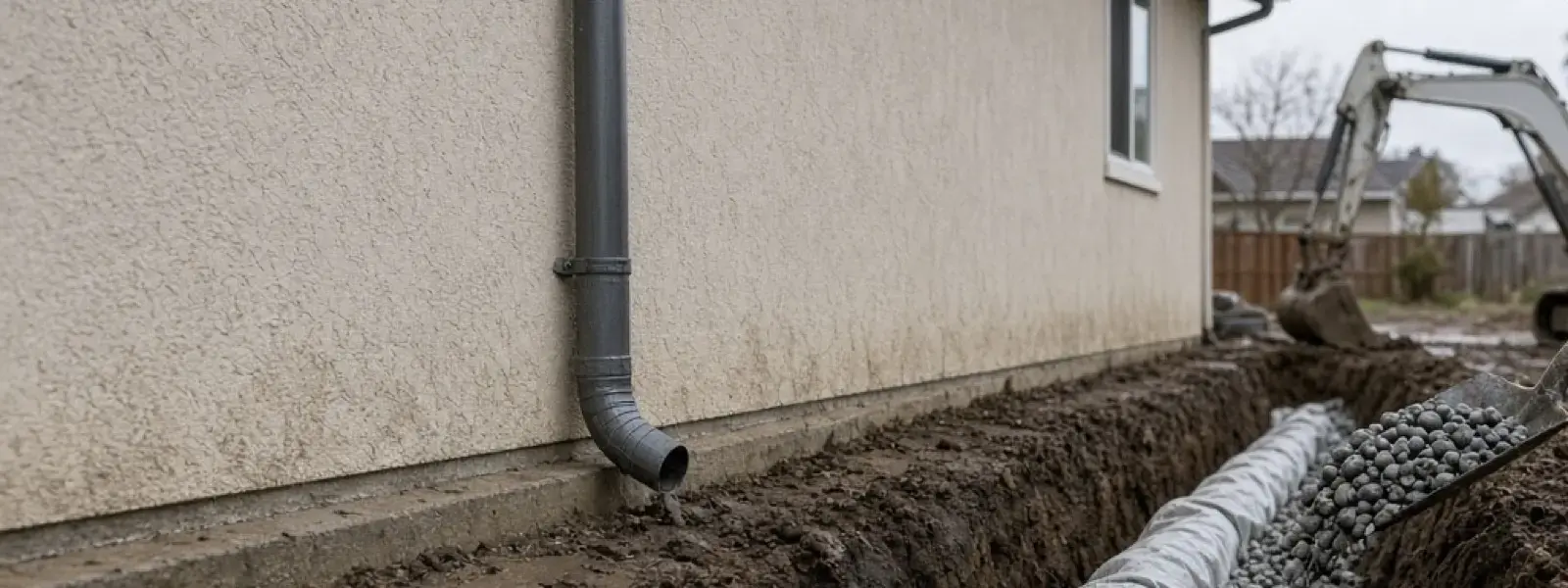
A trench is cut at a consistent fall, lined with non-woven geotextile, filled with a base layer of clean drain rock, then fitted with rigid perforated pipe. We cover it with more rock and wrap the fabric over the top. It's a simple system when it's built right, and a mess when it isn't.
When water runs across the surface, such as off a patio, driveway or a low corner of the lawn, a French drain won't catch it fast enough. We use slotted channel drains at doorways and patio edges, and catch basins or area drains at low points to take surface water into solid pipe.
From the collection points we run solid pipe, usually SDR 35 or similar rigid pipe, to a legal and safe outlet: daylight on your own slope, a curb drain, a pop-up emitter or a pump system when gravity can't get it done. Joints are glued, the pipe is bedded, and the slope is checked all the way.
Roof water is a lot of water. We tie downspouts into solid pipe with cleanouts rather than dumping them next to the foundation or into a perforated line, where the water just leaks right back out and re-saturates the soil.
Many jobs include moving some soil so the ground slopes away from the house. After the drain goes in, we restore the surface with sod, mulch, gravel or pavers depending on the area, and we haul away spoils. Clean-up is part of the job.
The build
We call USA North 811 before digging and stake the drain route after the lines are marked. We also check for irrigation lines, gas, power and sewer laterals, and mark the planned slope and exit point. Digging blind is how people hit a line, so we don't do it.
The trench is typically around 12 inches wide and anywhere from about 18 inches to 24 inches deep or more, depending on what it's protecting and where the exit is. We cut it to a consistent fall of at least 1 percent (about 1/8 inch per foot), and often steeper when we can get it. We use a laser level so the fall is real, not by eye.
Non-woven geotextile is laid in the trench with enough extra on the sides to wrap the whole stone package. We place a few inches of washed 3/4-inch drain rock as a bed so the pipe sits on stone, not on clay.
Rigid perforated pipe such as perforated SDR 35 goes in with the holes down, the joints connected, and the slope checked with the level again. We connect the end of the perforated run to solid pipe that carries water to the outlet.
More 3/4-inch washed rock goes over the pipe, then the fabric is folded over the top. This keeps silt out of the stone. Leaving the top open or covering the stone with plain soil lets fines wash in over time.
Channel drains, area drains, catch basins and gutter lines are connected into the solid line with proper fittings and cleanouts. Everything gets water-tested before it's buried.
We finish with soil, sod, mulch or gravel, grade the top so it sheds water into the drain, and test the system again with a hose. You see where the water goes before we leave.
Technical detail
A French drain doesn't pull water out of the ground like a straw. Water in saturated soil moves toward the easiest path, and a trench full of open rock is far easier to flow through than clay. So the drain intercepts groundwater and shallow seepage, gives it a low-resistance route, and carries it to an outlet by gravity. That's the whole trick, and it's why slope and outlet matter so much.
Surface water behaves differently. Water running over the ground doesn't always sink into the drain rock fast enough, especially if there's a layer of sod, mulch or soil above. For surface runoff, you want a channel drain, catch basin or regrading that moves the water into a solid pipe on its way out. We often combine a French drain for the seepage and surface drains for the runoff, because most Valley yards have both.
A French drain also won't fix a roof that dumps ten gallons a minute next to your foundation or a patio that slopes toward the house. We look at the source of water first. Sometimes the fix is a gutter extension, a grade correction and one short drain, not a 100-foot trench.
We prefer rigid perforated pipe, like perforated SDR 35 or a similar rigid pipe, set with holes down. The rigid wall keeps its shape and holds slope without sagging, and it can be flushed or snaked if it ever needs cleaning. Corrugated pipe costs less and is flexible, and it's fine in some situations, but it can sag between supports, collect silt in its corrugations and make it harder to keep a consistent fall. If the pipe has a sock, we skip it in favor of wrapping the entire stone package with fabric, since socks clog with fine clay.
Rock matters just as much. We use clean, washed 3/4-inch drain rock, angular and uniform in size, so there are open voids for water to flow through. Pea gravel is round and finer, and it packs differently, so it moves less water. Crushed rock with fines, like 3/4-inch minus road base, sets up almost like concrete and holds water rather than moving it. Washed means the dust is gone, and the dust is what clogs fabric.
Non-woven geotextile fabric keeps native soil out of the stone while letting water through. It wraps the sides and top of the stone package, with generous overlap. We don't use woven landscape fabric or plastic sheeting here, since they either clog or block flow. A properly lapped wrap keeps the silt out. A skimpy one lets it in, and the stone slowly fills.
Every drain is a slope. At least 1 percent is our minimum for pipe, and steeper is better when the site allows. The ground itself needs slope too. Building codes typically call for hard surfaces to slope at least about 2 percent (1/4 inch per foot) away from the structure, and for soil next to a foundation to fall about 6 inches over the first 10 feet, which is 5 percent. Many Valley yards from the 1950s to 1970s have settled flat or even back toward the house, and a few hours with a shovel and a laser level can fix more than a long trench can.
Where does the water go? That's the question we ask first. The best outlet is daylight on your own property, a lower corner of the yard with a pop-up emitter, a sloped swale or a spot where it can spread without eroding. Next best is a curb drain through the curb to the street, which many cities allow with rules. Connecting to a storm drain or sewer line is often restricted, and we check with the city rather than assume. The one rule that never changes: don't send water onto a neighbor's property. That's a legal problem and a human one.
When gravity can't do it, a sump pump can. A sump basin collects water from the drain, a pump lifts it to a discharge line, and a check valve stops it from running back. Pumps need power, a battery backup if the site calls for it, and regular testing. They're a solution for low sites, not a first choice.
A slotted channel drain is a long grate-covered trough, usually 4 or 5 inches wide, set at the edge of a patio, doorway or driveway apron. It catches sheet flow before it reaches the structure. Channels need their own slope or an internally sloped body, a solid outlet and a spot to clean them. They look neat when they're set flush and tied to a solid line.
Catch basins and area drains sit at low spots. A catch basin has a sump below the outlet so sediment drops out instead of rolling down the line. An area drain is a simple grate inlet. We use them where the grade can't be fixed by shaping alone, like a side yard that funnels water between two fences. These connect to solid pipe, not perforated, so the water moves in a closed line to the exit.
Gutters and downspouts are a big share of the water. A roof can deliver an enormous volume in a heavy atmospheric-river storm. Downspouts should drop into solid pipe with a cleanout and run to the outlet. Plugging a downspout into a perforated French drain near the foundation is a common mistake, because the water simply soaks out and saturates the soil you were trying to dry.
A dry well is a buried chamber or rock-filled pit that holds water and lets it soak into the ground. It works when the soil underneath drains well, like sandy or gravelly soil. On heavy Valley clay, percolation is poor, so a dry well can fill and stay full for days. Sizing needs a real percolation test and an honest look at the soil, and in some spots we'd recommend a different solution entirely.
Perched water is another clay issue. When a clay layer sits above deeper permeable soil or the water table, rainwater collects on top of it and creates a perched water table, even in places where deeper groundwater is far below. That water sits right at footing depth and won't drain down. French drains intercept perched water well, but it still needs an outlet.
In parts of the Valley, groundwater can also rise seasonally near creeks and low areas such as parts near the Guadalupe River and Coyote Creek. We hedge on this because it varies by block and year. A site with a high water table needs a deeper approach, sometimes a sump, and sometimes a conversation with a geotechnical engineer if there's a slab or structure involved.
Spec sheet
Failure modes
Most failures trace back to a handful of shortcuts. These are the ones we see most.
A drain that ends in a gravel pit is a trench of water. The exit must be lower than the drain's low end and must lead somewhere legal and safe. Check this before the first shovel goes in.
Eyeballing the fall is how pipes end up flat or sagging, with water sitting in the dip. A laser level along the whole run and at least 1 percent fall is the minimum, and we check it again at backfill.
Pea gravel moves less water, crushed rock with fines clogs and sets up hard, and no fabric lets clay migrate into the stone. The result is a drain that works for a season or two and then slows to nothing.
Holes up lets silt settle in the pipe, socks clog with fine clay, and sagging corrugated pipe makes low spots. Rigid pipe, holes down, with the stone package wrapped in fabric is a more reliable build.
Roof water into a perforated line near the house just soaks back into the soil. And pointing a pipe at a neighbor's yard is a legal and relationship problem. Both are avoidable with solid pipe and a legal outlet.
Santa Clara Valley ground
San Jose's flatland soils are heavily clay in many neighborhoods. That's good for holding up buildings and bad for soaking up water. After the first fall rains, the clay seals and runoff starts moving across the surface, then in a big storm it saturates and holds. A lot of homes from the 1950s to 1970s were built on lots graded flat with minimal drainage planning, and decades of concrete, additions and fences have made that worse.
Our climate is Mediterranean, with a dry summer and a wet season roughly from November to April. That means drainage work mostly gets tested all at once, during a few big storms. Atmospheric rivers can drop a lot of rain in a short time, and the ground might already be soaked from the storm before. Summers are the best time to dig, since the soil is workable, and the drain is ready when the rain returns.
Foothill lots around Almaden, Los Gatos and Saratoga have a different problem: slope and runoff from above, plus rocky soil that can slow digging. Lots near creeks have setback rules. Discharge rules matter everywhere. Cities have stormwater regulations and often restrict connecting yard drains to the storm system or sewer, so we check what your city allows rather than guess. Nothing here is a substitute for checking with the city and your HOA on any drainage change that crosses a property line or a creek setback.
Questions
It gives water an easier path than the surrounding soil. Water moves through the open rock into the perforated pipe, then flows by gravity along the slope to an outlet. It works on groundwater and shallow seepage. For surface runoff, we usually add channel drains or catch basins.
Trenches are typically around 12 inches wide and anywhere from about 18 to 24 inches deep or more, depending on the problem and outlet. The pipe needs at least 1 percent fall, which is roughly 1/8 inch per foot. More slope helps, as long as the exit works.
Washed 3/4-inch angular rock has large, open voids and moves water well. Pea gravel is smaller and rounder and moves less. Crushed rock with fines packs tight and holds water. Washed rock keeps the dust out of the fabric and the pipe.
A French drain is buried and catches water moving through the soil. A channel drain sits at the surface with a grate and catches water running across a patio, driveway or doorway. Many yards need both, tied into a solid discharge line.
Sometimes, but be careful. Clay percolates poorly, so a dry well can fill and stay full. It needs a percolation test and a size based on real soil behavior. In many cases, a surface outlet or a sump system works better.
Best is daylight on your own property. A curb drain to the street is often allowed with rules. Connections to storm drains or sewers are often restricted, so check with the city. Never direct water onto a neighbor's property.
Yes. In Northern California it's USA North 811, and you should call before any digging deeper than a few inches so utilities get marked. It's free, and marking takes a few working days, so plan ahead. We handle the call as part of a job.
Generally no. Downspouts should go into solid pipe with a cleanout and run to the outlet. A perforated pipe near the house lets the water leak right back into the ground you're trying to dry out.
Related work
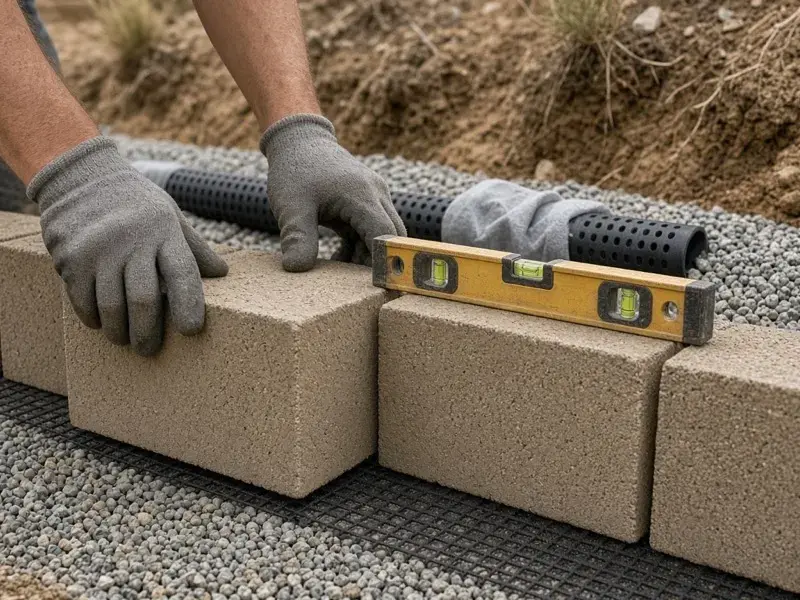
Segmental block, boulder, and poured walls for slopes, terraces and grade changes.
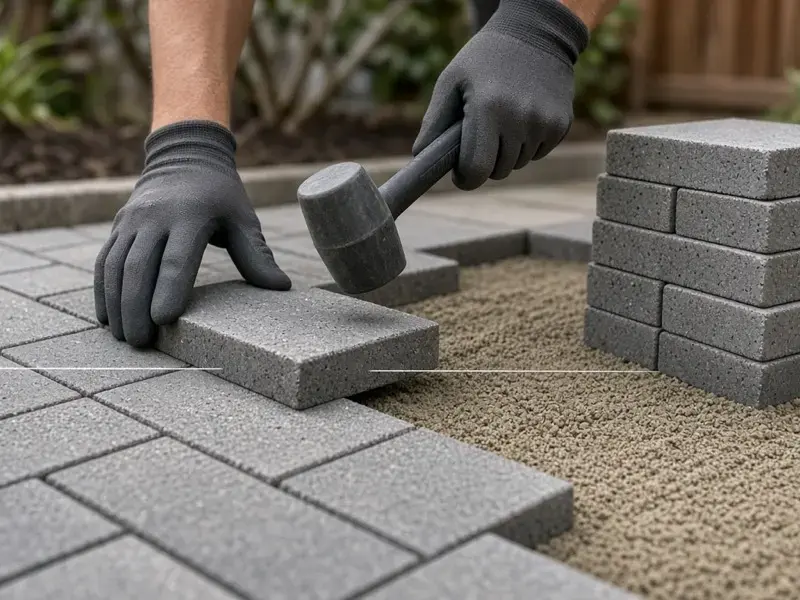
Herringbone, running bond, and custom layouts over a base built for Valley clay.
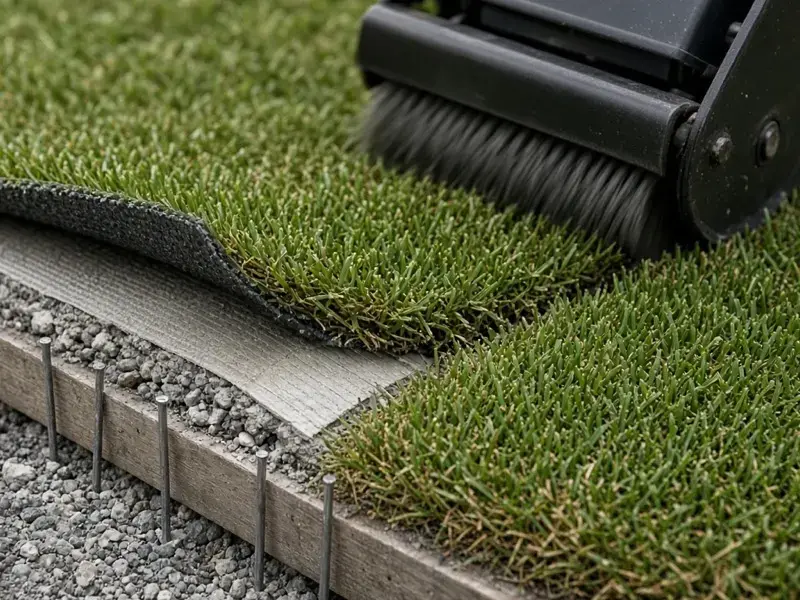
Synthetic turf over a compacted, free-draining base with seams you can't find.
If your yard stays soggy, your crawlspace smells damp or a patio keeps sinking, San Jose Hardscapes can walk the site, find where the water comes from, and lay out a drain, grade and outlet plan. We often pair drainage with a retaining wall on slopes, a paver patio that finally stays flat, or artificial turf over a base that drains.