Most drainage problems in San Jose don't show up in August. They show up in the first real storm of winter, when a puddle you never noticed turns into a pond against the back door. At San Jose Hardscapes, fall is the busy season for drainage calls, and we get it. Nobody thinks about water until it's coming toward the house.
The good news is that November is still early enough to fix most of it. The Santa Clara Valley wet season runs roughly November through April, and our clay soil doesn't absorb much once it's wet. Here's a walk-through of what to check, what each kind of fix actually does, and how to line up the work so it's finished before the ground is soaked.
Walk the yard during a real storm
The best drainage inspection happens in the rain. Put on a jacket, grab a flashlight if it's dark, and walk the whole property while water is moving. Where does it run? Where does it stop? Look for water sheeting off the roof edge onto the ground, streams that cut across the yard toward the house, and low spots that fill and stay full. Photograph or mark them with a flag, because those spots look completely different once the rain stops.
Check again an hour or two after the rain ends. Water that's still standing then is telling you something. In clay, a low spot that holds water is usually a spot where the soil can't take any more and there's nowhere for the water to go. Also look at the foundation line, the crawl space vents, and any door thresholds. If you can see staining, efflorescence, or damp soil right along the foundation, water is getting too close.
And don't forget what's coming onto your property from a neighbor's yard or a slope behind you. Sometimes the problem isn't what falls on your lot, it's what arrives from uphill.
Downspouts and grading come first
Before anyone talks about drains, deal with the roof. A typical house sheds an enormous amount of water in a storm, and if the downspouts dump at the foundation, that water goes straight into the soil along the footing. The fix is to connect each downspout to solid, closed pipe, not perforated, and run it well away from the house to a safe discharge point, such as a pop-up emitter, a daylighted slope, or a curb outlet where the city allows it. Splash blocks and short flexible extensions don't move enough water far enough.
Next is grading. Ground next to the foundation should slope away from the house. Building codes commonly call for around 6 inches of fall over the first 10 feet on soil, which works out to about 5 percent. Hard surfaces like patios and walkways need less, usually a minimum of 2 percent, or 1/4 inch per foot, because water runs off them cleanly. If your yard has settled over the years, or soil has built up against the house, you may have a flat or even a reversed slope that sends water the wrong way.
Grading is the least glamorous fix and often the most effective. Regrading the first several feet and building a gentle swale to a safe exit can solve a problem that would otherwise need a drain. One caution: don't pile soil or mulch above the siding line or the foundation sill plate, because that creates a bridge for moisture and pests.
Channel drains, French drains and catch basins
Different problems need different drains, and mixing them up is how people end up with a drain that doesn't help. A channel drain, sometimes called a trench drain, is a slotted grate set flush in a hard surface. It's for surface water, such as a patio or driveway that slopes into a garage or door. It catches sheet flow right where it arrives and carries it to a pipe. We often set one across the low edge of a patio or at the bottom of a driveway apron.
A catch basin is a box with a grate that collects water at a low point in a lawn or planting bed, then sends it down a solid pipe. It's the right tool for a spot that ponds and has somewhere lower to discharge.
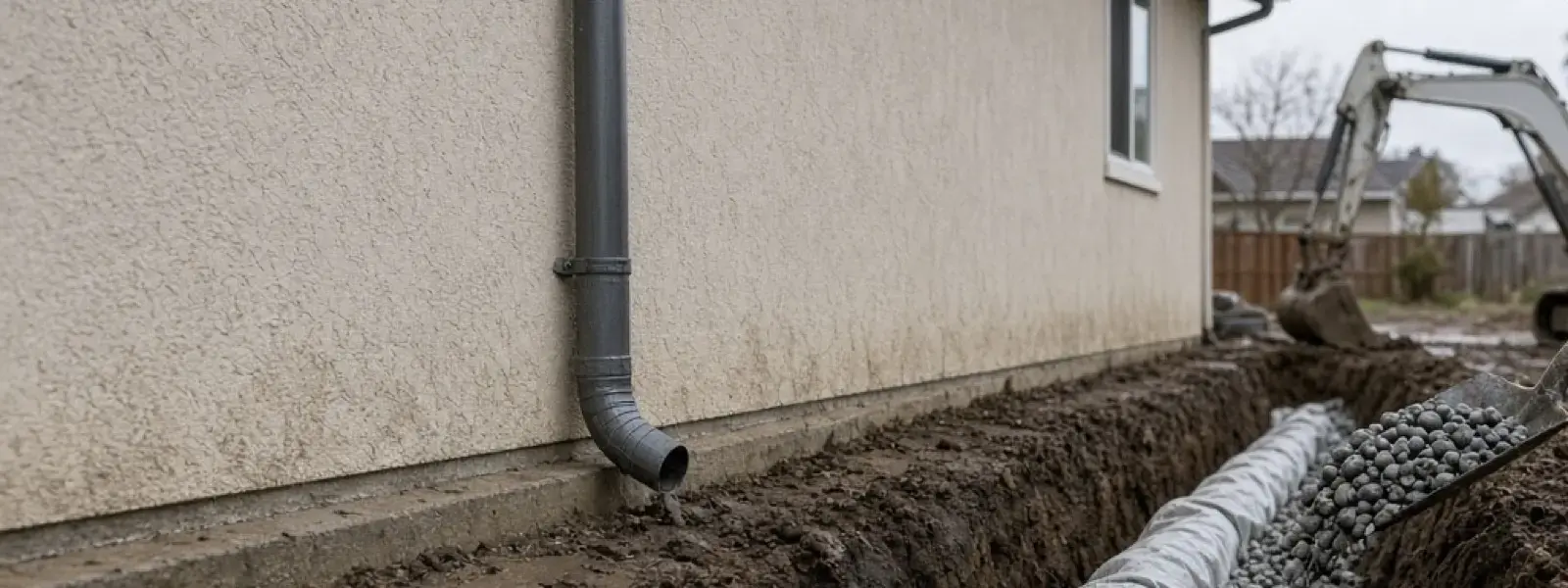
A French drain is a different animal. It handles groundwater and saturated soil, not surface flow. The classic build is a trench with a sloped bed, non-woven filter fabric lining it, a layer of washed 3/4-inch drain rock, SDR 35 perforated pipe with the holes facing down, more rock over the top, and the fabric folded over to keep silt out. The pipe needs a consistent slope, often 1 percent or about 1/8 inch per foot at minimum, and a clear outlet. A French drain with no outlet is just a long underground trough, and in clay it will fill and stay that way.
Why dry wells struggle in clay
People like the idea of a dry well because it sounds tidy: water goes down a pipe, into a pit, and soaks away. In sandy or gravelly soil, that can work well. In a lot of San Jose, it doesn't. Clay has very low permeability, and when it's saturated in the middle of winter it takes up water at a crawl. A dry well in clay often just becomes a buried tank that fills during a storm and drains over days, if it drains at all.
That doesn't mean they're always wrong. Soil conditions vary a lot across the valley, with some alluvial pockets draining much better than the flatland adobe. A percolation test, which is simply a hole dug and filled with water while you time how fast it drops, tells you what your soil does. We'd rather test than guess.
Where percolation is poor, the better plan is usually to move water out instead of trying to soak it in. That means piping to a lower discharge point, to a curb outlet or storm connection where local rules allow it, or to a landscaped swale with room to spread. If a dry well is used, it works best as a temporary buffer with an overflow pipe that leads somewhere real. Check with the city on what's allowed, because rules on where roof and yard runoff can go vary.
Window wells, low spots and the places people forget
A few trouble areas get missed on almost every walk-through. Window wells on basements or lower levels can fill like a bucket if the drain at the bottom is clogged or was never connected to anything. Clear the debris, check that the drain pipe actually leads away, and make sure the well has a cover that sheds water. Stairwells and sunken patios have the same issue.
Low spots in the lawn are usually either a settled trench from an old utility, an old tree stump, or the place where two grades meet. Sometimes filling and regrading solves it. Other times a catch basin and a short run of pipe is cleaner. Along fences and retaining walls, look for water collecting at the base. Walls need drainage behind them, and water pooling in front of one can undercut the footing. If you've got a wall in the picture, our retaining wall contractor page explains how drainage behind a wall is built.
Finally, check where your own irrigation goes. A broken head or a lawn that's overwatered right next to the house is a drainage problem you create yourself. Dry summers make it easy to forget, and then the wet season stacks winter rain on top of already damp soil.
Call 811, and order the work in the fall
Before any trench is dug, call 811 or submit a request online. It's the free national call-before-you-dig line, and the utility owners will mark gas, electric, water, sewer, and communication lines before work starts. Don't skip it, and don't assume your gas line or irrigation main is where you think it is. Utility markings only cover public lines up to the meter, so private lines like irrigation, yard lighting, and sewer laterals may need to be located separately.
Timing matters too. Drainage and grading are easiest to do in dry or barely damp soil. Once the ground is saturated, trenches collapse, the equipment tears up the lawn, and nothing can compact properly. Contractors also get booked up as soon as the first big storm hits, so the best time to call is before it does, ideally in early fall. We move quickly where we can, but scheduling depends on weather, access, and permits.
If a storm is already on the way, a temporary measure helps: clear gutters, extend downspouts with a hose or solid pipe, and move soil or mulch back from the foundation. Then plan the permanent fix. If the yard needs a new patio anyway, it's a good moment to build the drainage into it, as a paver patio with the right slope and a hidden channel drain handles runoff far better than one that was an afterthought.
Water is patient, and a drainage problem that's annoying this winter can be a damp crawl space or a cracked patio by next winter. If you've seen pooling, wet foundations, or runoff headed the wrong way, San Jose Hardscapes can walk the property with you, figure out where the water is coming from, and lay out a fix that makes sense for your soil and your lot. Fall is the right time to start.
Written by San Jose Hardscapes Team.